New Paragraph

OpEd: Illegal protests aside – is it time to end COVID-19 vaccine mandates?
February 5, 2022

Before Twitter erupts with accusations that I support illegal acts and community-crippling trucker protests, let me state unequivocally that I don’t. Nor do I, as a rule, believe that we should change public policy or legislation to meet the demands of law-breakers.

I am triple vaccinated and never questioned the need for mandatory vaccinations. Personally, I’d get dozens of shots to protect myself and my family/friends from being ill or dying from a virus. But that’s me. I respect the contradictory views of others.

A number of first responders are opposed to vaccine mandates – which I don’t support (See my OpEd: “Ontario’s Police Officers Should Be Vaccinated"). Similarly, a number of nurses and other hospital personnel are refusing to be vaccinated. Some Canadian Forces personnel are digging their heels in and risking dismissal. Personally, I do not agree with them either. They are all public servants that were hired to protect the public.


In the early days of COVID, truckers were allowed to cross the Canada/U.S. border as they hauled goods between countries without so much of producing a negative COVID test. They only had to show their passports to prove citizenship. That was through the worst of COVID variants. Restaurants, bars, gyms and a host of other establishments were in full lockdown. The rules around accessing hospitals and nursing homes were extremely challenging. In fact, it broke my heart that we were not able to visit our father when he died in a nursing home in 2020. But these rules were established for the betterment of the health of Canadians in very uncertain times.

Then vaccines were developed and delivered, slowly making their way into the arms of Canadians – including truckers. Cross-border rules got tighter and tighter for travellers crossing land borders, but not truckers. Even when the border was totally locked down, truckers still had the unfettered ability to cross. I thought that was crazy, but I also appreciated the need to meet supply chain demands.


Then in mid-January 2022, when the Omicron variant seemed to be flattening and provinces were loosening many COVID restrictions, provincial and federal rules were tightened, forcing truckers to have proof of vaccination in order to return from south of the border, and the U.S. established the same for those entering that country. At that point, almost 90 per cent of truckers had been vaccinated. So, in essence, there was a diminishing health risk as restaurants were opening to a larger degree. Truckers were largely vaccinated, but apparently, it was time to clamp down on them. It seemed oddly contradictory, but I’m neither a lawyer or a public health official. As the pro-vax guy that I am, I really didn’t care.


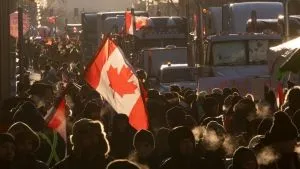
Fast forward to late January, and the truck convoy for “Freedom” began its cross-Canada trek to Ottawa to protest vaccine mandates. Even though the provinces own part of the mandate authority, the protest was focused on the nation’s capital. Highways were clogged and eventually the downtown core of Ottawa came to a standstill and was then plagued with blaring air horns 24/7. A host of other ridiculous and disturbing acts occurred and still do by people at least “associated” with the convoy. It’s a quandary of epic proportions, to say the least, and well past the realm of a “peaceful and lawful” protest. A similar blockade was also established on the international border in an isolated area near Coutts, Alberta. This weekend protests are occurring in a number of Canadian jurisdictions. None of it should have occurred and none of it should continue – plain and simple. This veiled attempt at “Freedom” has disrupted the lives of already stressed out Canadians that were all hoping a relatively manageable level of COVID was drawing near.


In the middle of this mess, a few provinces are easing a number of COVID restrictions in an attempt to manage Omicron more like how we currently address the flu. A number of countries around the world are taking similar action, some even returning to pre-COVID practices.


Is all of Canada heading that way soon? Protests aside, is it the right thing to do? I hope so, but who knows. The protestors don’t know either because they have yet to speak with provincial or federal health authorities. Instead, police are responsible to negotiate through this tense situation and then wear the results. The premiers and the prime minister all have a pile of officials beneath them that could at least protestors out and either explain where mandate rules are going, what they can or cannot do in terms of policy and why, and their inability to change any rules on the U.S. side.


If their position is that they will not have any dialogue while protests are ongoing, fine, say that and at least agree to have ongoing and structured dialogue between appropriate federal and provincial authorities and trucker representatives when the protests end.


The police will have to enact an “arrest and tow” solution soon. In fact, it’s probably a few days too late in both the Coutts and Ottawa scenarios, but it has to happen. It will be a large show of force. It will be resource-intensive and costly. People will be hurt without question. Lawsuits and investigations will result, and sympathetic protests will continue to emerge. It will be a drawn out and painful exercise but has to happen if the blockades don’t end immediately. That’s the only solution remaining if the protestors don’t get their way.


I fear that after all the smoke settles, Canada and the provinces will be afraid to remove additional mandates in the near term out of fear that the electorate will think that they “caved in to criminals.” It would be sad in my view IF making the changes is the truly right thing to do for Canada as a whole now, if governments hold off from making appropriate policy changes immediately for no other reason than the illegal protests and instead wait until the smell of tear gas dissipates from the air.


If it is the proper time for mandate changes, they should do it now and weather the political fallout later. If it truly isn’t the right time, then damn the torpedoes, full speed ahead.


As I say in my leadership lectures and writings: “How can it ever be wrong to do the right thing?”

Chris Lewis served as Commissioner of the Ontario Provincial Police from 2010 until he retired in 2014. He can be seen regularly on CTV and CP24 giving his opinion as a public safety analyst.

By Chris Lewis March 28, 2026
Leadership is inundated with risk, every hour of every day, in all sectors. In policing, legislative authorities and established policy are the ever-present guideposts, but occasionally policy just doesn’t apply. At times someone has to just make a decision to do something, or not, or they will fail the public they serve and the personnel it is their duty to lead. If it goes bad, time to own up, do damage control, learn from it and move forward. It always frightened me when I saw some at the senior executive level in policing think that supervisors and managers operate in a pristine little bubble where nothing should ever go wrong. Then when it did because some supervisor tried their best to make something work for all the right reasons, they wanted to pigeon-hole the person that took the risk. There were times during my own career when executives were not encouraged to take any risk either. In fact, taking risk was career risk in itself. Despite the best of intentions, if it went bad, the one ‘responsible’ be forever labelled as having failed. Even if the gamble went well, the jaundiced eyes from above would still forever look at them as being a potential liability. It became the “Oh, him. He’s the one that...” At times the daily decision making of high-level commanders would be second-guessed by those in the executive suites – some of whom had never really commanded anything. My buddy retired Chief Wayne Frechette used to describe these folks as: “They’ve never been out after dark on company time.” I know this same concept was alive in many other police services. Some at executive levels actually did serve in operational roles at some point but they never took a risk. Somehow, they were fortunate to skate through difficult situations through sheer luck as opposed to good decision-making and never developed any scar tissue along the way. They didn’t learn from failure – they survived by luck. They also were viewed by weak executives above them as being golden because there was never a milli-second of negativity around them. They were Teflon. But those that worked under their “command” (for lack of a better word) had no respect for them. They simply watched them walk around with coffee in hand, never leaving the office or making a decision. It wasn’t leadership, but it did pave the way to stardom from on high, for some. True leaders do take risks at times. Many I worked with and for did it all and did it well. They did so in the best interests of those they served and those they led, because it wasn’t about themselves, but was done in the service of those that placed their trust in them. Policy simply doesn’t fit every situation. It is most often a guide that anticipates most circumstances that employees will face, particularly the more common (high-frequency) ones. But it cannot predict every possible scenario. When that happens in policing, it can occur in very unlikely situations (low-frequency) that are incredibly high-risk. Supervisors cannot say “Sorry folks, the book doesn’t cover this one” and run away crying. They also don’t have time to tell bad guys, “Hey big fella, sit tight. We need to take a pause here and get the whiteboard out so we can have a group-think about how to stop your murderous rampage.” I think that many pseudo-leaders – far too many, are afraid to make risky decisions out of fear that an error will jeopardize their career. Instead, they risk their careers by not making decisions. Or as I like to say: “their fear of career-risk, risks their careers.” This can be fatal in the policing world. When a police supervisor shirks their responsibilities or quivers, sucks their thumb, and prays for the situation to go away, thankfully constables will come forward and do their best to get their teammates through it. Sometimes that ends well and when the supervisor emerges from their fear-induced coma, they will more often than not take credit for the success. But when the situation goes to hell-in-a-handbasket – despite best efforts, the pseudo-leader will document the risk-taking employee and add another bullet-point to their list of things they’ve done to “hold people accountable.” The panel at their next promotional interview will likely hear the false rendition proudly told. I hear examples of this practise from serving police officers across North America on a much too frequent basis. True leaders develop a culture of trust among those they lead that their suggestions and feedback are encouraged and valued. Their confidence that the leader wants their input encourages them to constantly analyze situations and give thought to what policy says and the options available when policy says nothing. That is good for the employee’s development and may save the leader’s hind-end and the continuity of the team on occasion when an employee steps forward in a crisis. Having said that, there will clearly be situations where there isn’t time for the whiteboard, and a decision needs to be made by the responsible “leader.” When it doesn’t work out, the real leader will step forward and be accountable. But when it does go well, the true leader will allow the light to shine on the team they have the honour to lead. In my view, we’re not seeing enough of that in North American policing. We need more genuine leaders at all levels of law enforcement organizations. Developing and promoting real leaders that can manage risk effectively is a must. Anything less fails everyone.
By Chris Lewis March 26, 2026
They used to be simply a "nice to have."
By Chris Lewis March 18, 2026
The March 17 th announcement by the Toronto Police Service (TPS) regarding the Ontario Provincial Police (OPP) investigation into allegations by an Ontario Justice that three TPS officers colluded and lied during a 2024 murder trial against a man that ran over and killed TPS Constable Jeffrey Northrup in 2021, has further inflamed the debate over who should investigate alleged police wrongdoing. This instance combined with the recent arrests and ongoing police investigation into several TPS officers for their alleged involvement with organized crime, has brought this discussion to a boiling point. I appreciate the public perceptions around this investigative model given that the average citizen doesn’t necessarily understand the professionalism and commitment of police investigative teams like the recent OPP Criminal Investigation Branch (CIB) group. I have all the confidence the world in that team, but I also personally know the ability and integrity of the OPP Detective Inspector in-charge. So, if these investigations aren’t carried out by police, who will do them? They do not fall under the mandate of the Ontario Special Investigations Unit (SIU), which by the way is largely comprised of former police criminal investigators and forensic identification experts, many of whom investigated homicides in police services. For SIU to assume a larger role, they would have to grow exponentially and expand their team of ‘former cops’. These cases generally do not fall under the purview of Ontario’s Inspectorate of Policing either. They would loosely fall under the oversight role of Ontario’s Law Enforcement Complaints Agency (LECA), who is responsible for receiving, managing and overseeing public complaints against police, but frankly they don’t have mandate or the horsepower to conduct complex criminal investigations. They oversee the “public complaints” that may lead to a criminal investigation, but the investigation would be the responsibility of a police service to conduct. An expansion of the LECA would require a tremendous amount of funding and human resources, most of whom would also be former police officers. Hiring and training civilians to conduct such investigations is an option, but largely an incomprehensible one. Police criminal investigators are trained officers that generally start out as uniformed officers responding to occurrences and investigating more routine and less serious crimes, i.e. minor assaults and property crimes. They build investigative expertise over time, including in interviewing and interrogation; gathering and securing physical evidence; legal processes like obtaining judicial authorizations; presenting evidence in court; and various investigative strategies. They learn how to work with special police units that provide specific investigative skills, and more. All of this doesn’t happen overnight, but over a period of years and with the tutelage of more experienced investigators along that journey. Trying to turn a group of young and well-educated civilians – no matter how intelligent and well-intended, into a team of elite investigators, would be a complete disaster and unfair to the public or to the officers being investigated. Over my many years as a member or as the Director of the OPP CIB, my colleagues and I investigated criminal allegations against cops from other agencies. Before the SIU was formed, we investigated officers from many Ontario police services – large and small, who had used deadly force. Many were cleared and a number were arrested and charged. We also investigated criminal allegations against police chiefs in Ontario. Again, several were appropriately cleared, and some were brought before the courts. Municipal, provincial and federal elected officials were similarly investigated and some charged. Our members also investigated police officers in other provinces, including high-ranking ones. I personally investigated two Royal Newfoundland Constabulary officers that were involved in an arrest that result in the death of a suspect. They were properly exonerated, but I would have charged them in a heartbeat if they had wrongfully killed than man. I arrested an OPP Sergeant for sexual assault. A CIB colleague investigated and arrested two different OPP officers for criminal offences. Both of those officers had been personal friends of mine and years later committed suicide. There are tons of similar examples that I can refer to over my career. All of these involved the oversight and legal analysis of a Crown Attorney, sometimes from another province. The interesting thing, and what most of the anti-police folks will never believe, is that in every single one of those investigations, the dialogue that I was involved in with other officers that I worked with or supervised, involved doing what was right. In other words, “If the allegation is substantiated, we will put the case together, arrest them and put them before the courts.” Not even once, did we think about or do anything that would give an officer a pass when they committed a criminal offence. Never. I have every confidence in the world that the vast majority of municipal and RCMP colleagues across Canada would operate under the same guiding principle. Has the occasional officer worked in conflict with that approach? Undoubtedly. Were some investigators not as committed or capable as they should be and perhaps did a poor investigation accidentally or deliberately? Quite likely so. But I truly believe those cases are the exception, not the rule in criminal investigations. Where I more often believe poor investigations or deliberate attempts to inappropriately give a colleague a break continues to occur, is in Police Act investigations, where policy or employee harassment wrongdoings are suspected. I like to think that the focus on that continues to improve, but not fast enough in some cases. Sadly, I know now that unbeknownst to me at the time, it happened under my watch. A focus for my next article. The public and police deserve the very best of investigators to ensure that bad cops are effectively put out of business and good officers are cleared. If there’s another effective option that would appease the doubting public – aside from using current officers from other agencies or creating a new and costly entity that would be staffed by former police officers, I’d like to hear it.